
Subterranean vs Drywood Termites in Placer County
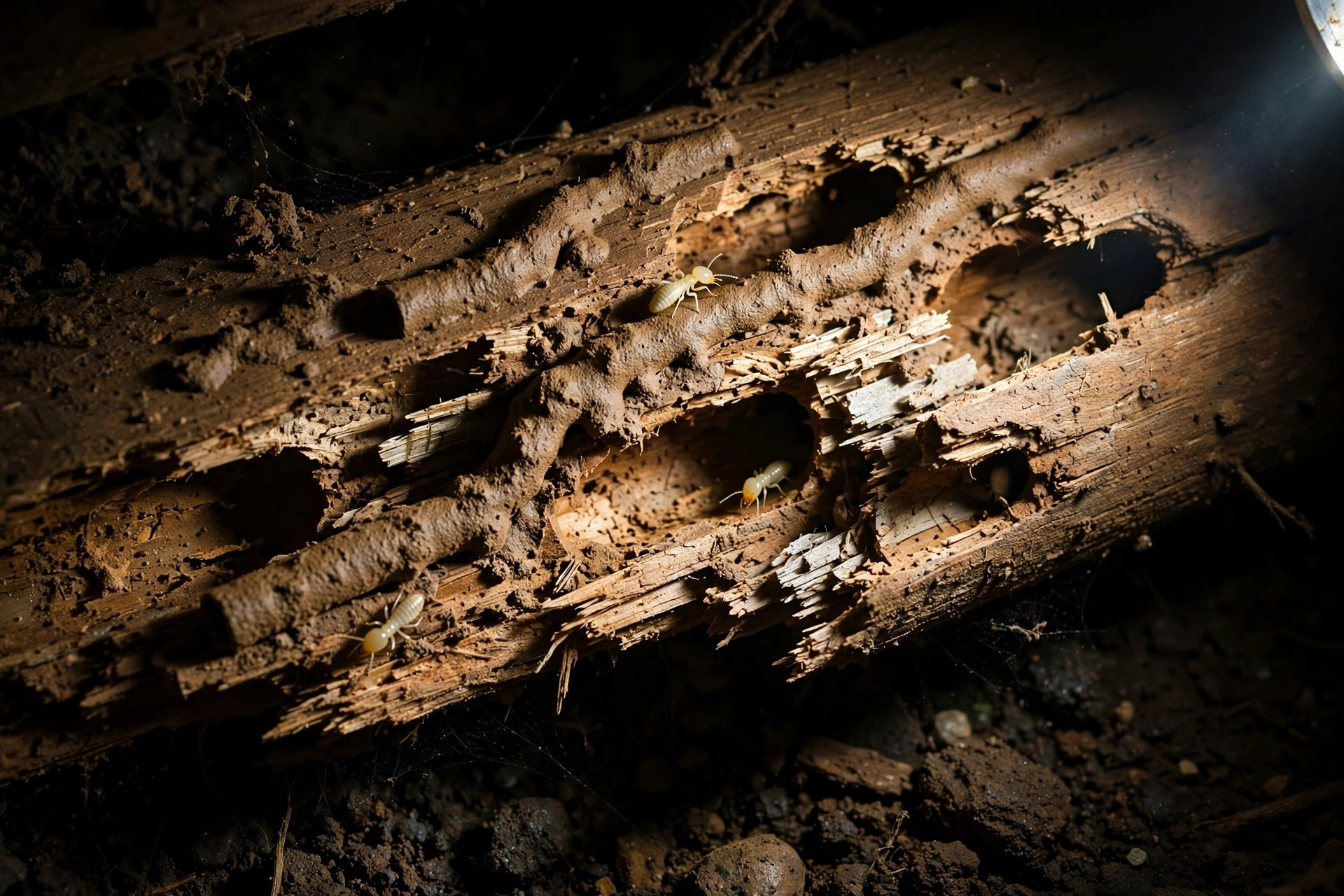
Subterranean termites live in the soil and build mud tubes to reach wood; drywood termites live entirely inside the wood and push out dry fecal pellets. Both occur in Roseville. The species are the western subterranean termite (Reticulitermes hesperus) and the western drywood termite (Incisitermes minor), and each needs a different treatment.
How Do You Tell Subterranean and Drywood Termites Apart?
You tell subterranean and drywood termites apart by the evidence they leave, not by the insects themselves.
| Attribute | Subterranean termites | Drywood termites |
|---|---|---|
| Colony location | Soil, connected to wood | Inside the wood, no soil contact |
| Main sign | Mud tubes, pencil-width, on foundations and piers | Frass: hard pellets about 1 mm long with six flat sides |
| Damage pattern | Galleries along the grain, packed with soil | Smooth, clean galleries across the grain |
| Where in a Roseville home | Crawl spaces, slab cracks, wood touching soil | Attics, window frames, eaves, furniture |
| Swarm timing | Daytime, often after the first fall rains and in spring | Warm, sunny days in late summer and fall |
| Typical treatment | Soil treatment or bait stations | Local wood treatment or whole-structure fumigation |
Which Termite Is More Common in Roseville?
Subterranean termites are the more common termite in Roseville, because the inland valley soil stays moist under irrigated landscaping. Drywood termites are more common near the coast, but they are regularly found in Roseville attics and older wood trim. A Roseville home can host both at once, which is why the WDO report names each species separately.
What Do Termite Swarmers Look Like?
Termite swarmers are winged reproductives with straight antennae, a thick waist and four wings of equal length. Flying ants differ in three ways: elbowed antennae, a pinched waist and front wings longer than the back wings. Western subterranean swarmers are dark brown to black. Western drywood swarmers are larger, with a reddish-brown head.
How Is Each Termite Treated?
Each termite is treated where its colony lives.
- Subterranean: a liquid termiticide barrier in the soil around and under the structure, or a bait-station system that colony workers feed on.
- Drywood, localized: injection or foam treatment into accessible infested wood.
- Drywood, widespread: whole-structure fumigation under a tent, when colonies are inaccessible or numerous.
Pest Control Pros confirms the species before recommending termite control in Roseville, because a soil treatment does nothing for drywood termites.
What Should You Do If You Find Termite Evidence?
If you find termite evidence, photograph it, leave it in place and book an inspection. Do not spray store-bought insecticide on tubes or frass; it rarely reaches the colony and it removes the evidence an inspector uses to identify the species. Our guide to mud tubes on your foundation covers the first 48 hours step by step.
Frequently Asked Questions
Yes, subterranean termites enter slab homes through expansion joints, cracks and plumbing penetrations as narrow as 1/32 inch.
No, drywood termites get the moisture they need from the wood itself, which is why they infest dry attic framing.
Western subterranean termites typically swarm on warm days after the first fall rains and again in spring; western drywood termites swarm on sunny days in late summer and fall.
Related Roseville Pest Guides
Mud Tubes on Your Foundation: What to Do in the First 48 Hours
What to do — and what not to disturb — when you find termite tubes.
Pest Inspection for Home Buyers in Roseville, CA
The termite, rodent and moisture findings sellers hope you will not look for.
Roseville Pest Calendar: What to Expect Each Season
Wasps in summer, rodents in fall, ants after rain — your year in Roseville pests.